
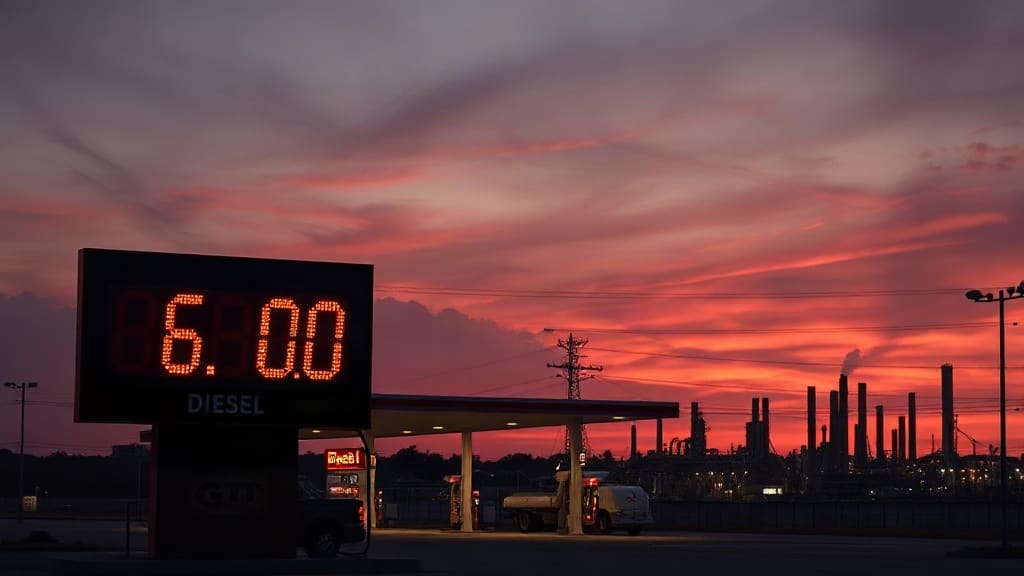
The steady drumbeat of rising oil prices has turned into a roar. Diesel has now crossed the $6 per gallon threshold in several parts of the country, a level that would have seemed unthinkable just a few months ago. The catalyst? Mounting tensions in the Middle East that have traders, policymakers, and everyday consumers on edge. As geopolitical risks intensify, the oil market is sending a clear signal: uncertainty has a price, and it's being felt at the pump.
For drivers, fleet operators, and businesses that rely on diesel, the latest spike is more than a headline. It's a direct hit to operating costs, supply chains, and household budgets. The question on everyone's mind is how high prices can go and how long the pain will last.
What's Driving the Surge in Oil Prices?
The current rally in crude oil is not the result of a single event but a convergence of geopolitical flashpoints and market fundamentals. At the center is the escalating conflict between the United States and Iran, which has raised the specter of a broader regional war. Any disruption to the Strait of Hormuz, a critical chokepoint through which roughly a fifth of the world's oil passes, would send shockwaves through global supply.
Beyond the immediate military tensions, there's a persistent undercurrent of supply anxiety. OPEC and its allies have maintained production cuts, keeping inventories tight. Meanwhile, demand has remained surprisingly resilient despite high prices, particularly in the transportation and industrial sectors. This combination of constrained supply and steady demand leaves little cushion for unexpected shocks, making the market hypersensitive to any news out of the Middle East.
The Role of Speculation and Market Psychology
It's not just physical barrels that are moving the market. Futures trading and speculative positioning have amplified the price swings. When headlines flash with the possibility of conflict, algorithmic trading and risk-averse investors pile into oil contracts, driving prices higher even before any actual supply disruption occurs. This creates a feedback loop where fear itself becomes a market force, magnifying the impact of every development.
Diesel's Dramatic Climb to $6 a Gallon
Diesel prices have been particularly volatile. Unlike gasoline, which is more sensitive to consumer driving habits, diesel is the lifeblood of commerce. Trucks, trains, ships, and farm equipment all run on diesel, making its price a direct input cost for nearly every good that moves through the economy. When diesel hits $6 a gallon, the ripple effects are immediate and widespread.
In many regions, diesel prices have outpaced gasoline due to a combination of factors. Refinery capacity constraints, seasonal demand for heating oil, and the global competition for distillate fuels have all tightened the diesel market. The added geopolitical risk premium has pushed diesel to levels not seen since the early days of the pandemic recovery, and for some areas, it's a new all-time high.
Regional Variations and the Pain at the Pump
While the $6 mark is a national milestone, the reality varies by state and locality. Higher-tax states and those far from refining hubs are seeing even steeper prices. In California, for instance, diesel has long been among the most expensive in the nation, and the current surge has pushed some stations well above $7 a gallon. For long-haul truckers, who may burn hundreds of gallons a week, the additional cost is staggering.
Economic Ripple Effects: From Freight to Food
The impact of rising diesel prices extends far beyond the fuel station. Freight costs are climbing, and those increases are passed along the supply chain. Shipping surcharges are becoming more common, and retailers are beginning to adjust prices to account for higher transportation expenses. The result is a broad-based inflationary pressure that complicates the Federal Reserve's efforts to bring inflation under control.
Agriculture is another sector feeling the squeeze. Farmers rely on diesel for tractors, harvesters, and irrigation pumps. With planting and harvest seasons in full swing, the higher fuel costs cut directly into farm income. This, in turn, can lead to higher food prices down the line, adding another layer of financial strain for households already dealing with elevated grocery bills.
Impact on Small Businesses and Local Economies
Small businesses, particularly those in logistics, construction, and delivery services, are especially vulnerable. Many operate on thin margins and lack the ability to absorb sudden fuel spikes. Some are being forced to add fuel surcharges, renegotiate contracts, or, in the worst cases, reduce services. The cumulative effect can slow local economic activity, particularly in rural areas where distances are greater and diesel dependence is higher.
How Are Governments and Markets Responding?
Policymakers are walking a tightrope. On one hand, there's pressure to release strategic petroleum reserves or provide direct relief to consumers. On the other, such interventions can be seen as short-term fixes that don't address underlying geopolitical risks. The Biden administration has indicated it is monitoring the situation closely, but has not announced any immediate emergency measures.
In the markets, the response has been a flight to safety. Energy stocks have outperformed, while airlines and other fuel-intensive industries have seen their shares come under pressure. The dollar has strengthened as investors seek safe havens, which paradoxically makes oil more expensive for buyers using other currencies, potentially dampening global demand.
The Strategic Reserve Question
The United States Strategic Petroleum Reserve (SPR) is at historically low levels after previous releases intended to cool prices. While another release is possible, its impact would likely be limited and temporary. The market is now more concerned about the medium-term supply outlook, and a one-time drawdown may do little to change that calculus. This leaves few immediate levers for policymakers to pull.
What Happens Next? Scenarios and Outlook
The path forward for oil and diesel prices hinges almost entirely on geopolitical developments. If tensions de-escalate and diplomatic channels open, we could see a rapid unwinding of the risk premium, potentially bringing diesel back below $5 a gallon. However, if the conflict widens and disrupts actual oil flows, prices could spike dramatically, with some analysts warning of $150 a barrel crude and diesel well above $7 a gallon.
For businesses and consumers, the prudent approach is to prepare for continued volatility. Hedging strategies, fuel efficiency improvements, and contingency planning are becoming essential. In the longer term, this latest crisis may accelerate the push toward alternative fuels and electrification, as the economic pain of diesel dependence becomes too great to ignore.
Consumer Advice: Weathering the Storm
For the average driver, there are a few practical steps to mitigate the impact. Consolidating trips, maintaining proper tire pressure, and reducing idling can improve fuel economy. For those considering a new vehicle, the calculus around diesel versus hybrid or electric options has shifted. The current price environment makes fuel efficiency a more urgent priority than ever.
Frequently Asked Questions
Why are oil prices rising so quickly?
Oil prices are rising due to a combination of escalating Middle East tensions, particularly between the US and Iran, which threaten supply routes, along with tight global inventories from OPEC production cuts and resilient demand. Speculative trading has also amplified the price movements.
How high could diesel prices go if the conflict escalates?
If the conflict disrupts major oil flows, such as through the Strait of Hormuz, diesel prices could surge well beyond $7 a gallon, with some analysts projecting $8 or more in heavily affected regions. However, if tensions de-escalate, prices could retreat quickly.
What can small businesses do to cope with high diesel costs?
Small businesses can implement fuel surcharges, optimize delivery routes, invest in more fuel-efficient vehicles, and explore bulk purchasing agreements. Some may also consider shifting to alternative fuels or renegotiating contracts to share the cost burden with clients.
Will the government release emergency oil reserves to lower prices?
While a release from the Strategic Petroleum Reserve is possible, its effectiveness would be limited because reserves are already at low levels and the current price spike is driven by geopolitical fear rather than an actual supply shortage. A release might provide only temporary relief.
Is this a good time to switch to an electric vehicle?
For many consumers, the high cost of diesel and gasoline makes electric vehicles more financially attractive, especially with available tax incentives. However, the decision depends on individual driving needs, charging infrastructure availability, and upfront costs. The current price environment may accelerate the transition for some buyers.