
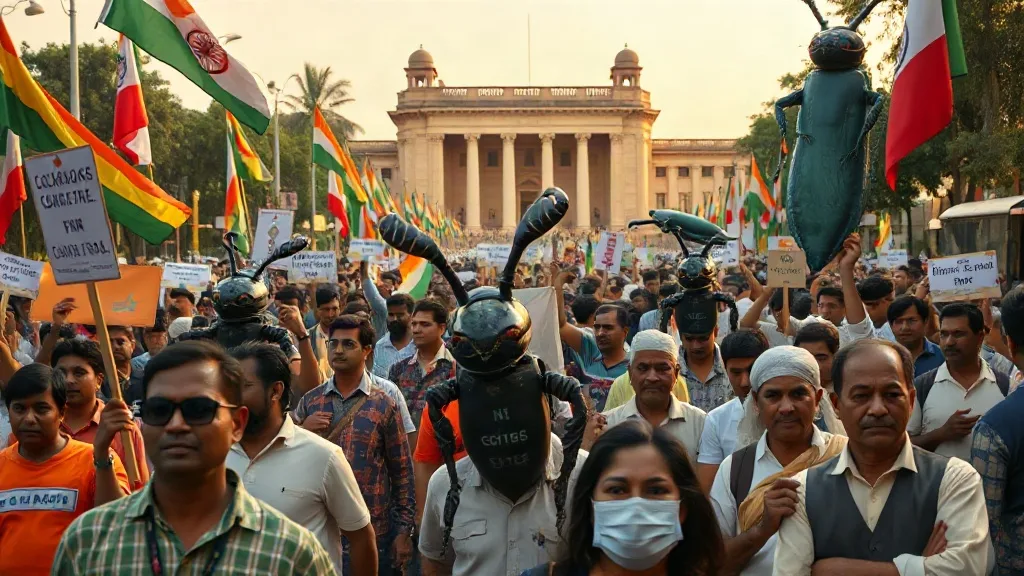
The streets of several Indian cities have become stages for an unusual form of political theatre. Protesters, many wearing cockroach costumes or carrying plastic roaches, are demanding the removal of the chief election commissioner over allegations of voter fraud. The imagery is deliberate: a sarcastic nod to a time when a top minister allegedly referred to opposition activists as 'cockroaches.' Now, the label has been reclaimed, and the irony is sharp. What began as scattered demonstrations has grown into a broader movement questioning the integrity of India's electoral machinery. In response, Prime Minister Narendra Modi has sought to reframe the narrative, calling India the 'mother of democracy' and emphasizing its ancient traditions of democratic governance. The clash is not just about one election or one official; it is about the story India tells itself and the world about its democratic credentials.
The Cockroach Protests: Origins and Escalation
The protests trace back to allegations of irregularities in recent state elections, where opposition parties claimed that electronic voting machines were manipulated and voter rolls tampered with. The chief election commissioner, the target of the protesters' ire, has denied any wrongdoing, but calls for resignation have only grown louder. The 'cockroach' motif emerged after a senior leader from the ruling party reportedly used the term to describe those challenging the election results. Activists seized on it, turning an insult into a symbol of resilience. In cities like Mumbai, Kolkata, and Chennai, marches have featured giant inflatable cockroaches and slogans demanding accountability. The movement has no single leader, which makes it both diffuse and difficult to dismiss. It has also attracted support from civil society groups, students, and even some business leaders concerned about the stability of democratic institutions.
Why the Symbol Matters
Symbols in politics are never accidental. The cockroach, often associated with persistence and survival, becomes a metaphor for the protesters' determination. It also mocks the alleged elitism of those in power. By adopting the label, protesters flip the script: they are not vermin to be exterminated but citizens demanding their voice be heard. This kind of creative resistance has a long history in India, from Gandhi's salt march to the anti-corruption movement of the 2010s. It resonates because it is visual, shareable, and deeply human. For a global audience, the image is jarring and memorable, which helps explain why the story has traveled beyond India's borders.
Modi's 'Mother of Democracy' Defense
Prime Minister Modi's response has been calibrated. Rather than directly addressing the fraud allegations, he has chosen to elevate the debate to civilizational terms. India, he argues, is the 'mother of democracy,' a reference to ancient republics like the Mahajanapadas and the tradition of village councils that predate Western models. This framing serves multiple purposes. It reminds Indians of their proud heritage, subtly suggesting that modern electoral disputes are minor bumps in a long journey. It also positions India as a global democratic leader, especially at a time when democracy is under strain worldwide. However, critics say the rhetoric dodges the substance. They point out that invoking ancient history does not address contemporary concerns about the independence of the election commission or the fairness of the voting process. The gap between the lofty ideal and the on-ground reality is precisely what the protesters are highlighting.
The Political Calculus
Modi's defense is also a political strategy. By framing the protests as an attack on India's democracy itself, he can portray the opposition as anti-national or as tools of foreign interests. This narrative has worked before, helping his party win elections despite controversies. But the current protests are different: they are decentralized, leaderless, and driven by a genuine grassroots anger that is harder to label. The business community, which typically prefers stability, is watching closely. Some investors worry that prolonged unrest could affect India's image as a reliable destination for foreign capital. Others see it as a sign of democratic vitality that ultimately strengthens institutions. The stock market has shown only mild fluctuations, suggesting that markets are not yet pricing in a major crisis. Still, the longer the protests continue, the more they could dent confidence.
Implications for India's Business Environment
For global businesses, India's democratic stability is a key pillar of its appeal. The country has attracted record foreign direct investment in recent years, buoyed by economic reforms and a large consumer market. But political uncertainty can be a deterrent. If the protests escalate and the government responds with heavy-handed tactics, it could raise questions about the rule of law and the protection of minority rights. Multinationals are already navigating a complex regulatory landscape; adding political volatility to the mix makes planning harder. On the other hand, a robust democratic debate can lead to stronger institutions over time. Companies that prioritize environmental, social, and governance (ESG) criteria will be watching how the government handles the protests. A peaceful resolution that addresses the protesters' concerns could enhance India's reputation as a mature democracy. A crackdown, however, could trigger criticism from international investors and consumers.
Sector-Specific Impacts
Certain sectors are more sensitive to political risk than others. Technology firms, for instance, rely on a stable policy environment for data protection and digital payments. Any disruption to governance could delay key legislation. The manufacturing sector, a focus of the 'Make in India' initiative, needs consistent power and labor stability. Prolonged protests could disrupt supply chains if they spread to industrial hubs. The financial services industry, already dealing with bad loans and regulatory changes, might see increased volatility. Even agriculture, which employs nearly half of India's workforce, could be affected if rural unrest grows. So far, the protests have been largely urban and middle-class, but their expansion cannot be ruled out. Business leaders are advised to monitor the situation closely and maintain contingency plans.
The Global Democratic Context
India's internal debate matters beyond its borders. As the world's largest democracy, its handling of electoral disputes sets a precedent. Western nations, which often hold up India as a counterweight to China, are watching with a mix of hope and concern. The United States and European Union have historically been reluctant to criticize India on democracy, prioritizing strategic ties. But if the protests grow and allegations of fraud are substantiated, pressure to speak out could increase. Meanwhile, authoritarian regimes may use the unrest as propaganda, pointing to flaws in democratic systems. Modi's 'mother of democracy' claim is thus a direct rebuttal to such narratives. It asserts that India's democratic heritage is deep enough to withstand current challenges. Whether that claim holds depends on how the government and the protesters resolve their differences.
The Role of the Election Commission
At the heart of the controversy is the Election Commission of India, a constitutional body responsible for conducting free and fair elections. Its independence is crucial to public trust. The protesters allege that the commission has become a rubber stamp for the ruling party, a charge it denies. The commission has announced reforms, including the use of VVPAT (Voter Verifiable Paper Audit Trail) in more polling stations, but critics say these are insufficient. The credibility of the commission is on the line. If it fails to address the concerns, it risks eroding the very foundation of Indian democracy. The government, for its part, has defended the commission's autonomy and accused the opposition of manufacturing a crisis. The standoff is a test of institutional resilience.
What to Watch Next
The coming weeks will be decisive. If the protests remain peaceful and the government engages in dialogue, India can emerge stronger, with renewed faith in its democratic processes. If, however, the situation escalates into violence or mass arrests, the narrative of 'mother of democracy' will ring hollow. International media coverage will play a role, shaping perceptions. Business leaders should pay attention to three indicators: the number of protests in major commercial centers, the government's willingness to negotiate, and the response of the Election Commission. Any of these could shift the trajectory. For now, the cockroach has become an unlikely emblem of resistance, and its story is far from over.
Frequently Asked Questions
What are the 'Cockroach' protests in India?
The 'Cockroach' protests are a series of demonstrations demanding the removal of the chief election commissioner over alleged voter fraud. The name comes from a derogatory term allegedly used by a ruling party leader to describe opposition activists, which protesters have reclaimed as a symbol of their movement.
Why did Modi call India the 'mother of democracy'?
Prime Minister Modi used the phrase to emphasize India's ancient democratic traditions and to counter criticism of the current electoral process. It is a rhetorical device to elevate the debate and project national pride.
How do these protests affect foreign businesses in India?
Prolonged protests can create political uncertainty, which may deter foreign investment. However, if resolved peacefully, they can demonstrate democratic strength and improve India's image. Businesses should monitor the situation and assess sector-specific risks.
What is the Election Commission's role in the controversy?
The Election Commission is responsible for conducting elections. It has been accused of bias and incompetence by protesters. Its response to the allegations will be critical in restoring public trust.
Are the protests likely to spread across India?
They have already spread to multiple cities. Whether they become a nationwide movement depends on the government's response and the opposition's ability to sustain momentum. So far, they remain largely peaceful.